September 17, 2026
Shopify Deleted Product 404: Where Should the Old URL Redirect?
A practical decision framework for handling deleted Shopify product URLs with replacement-product redirects, collection fallbacks, or a true 404 when no relevant destination exists.
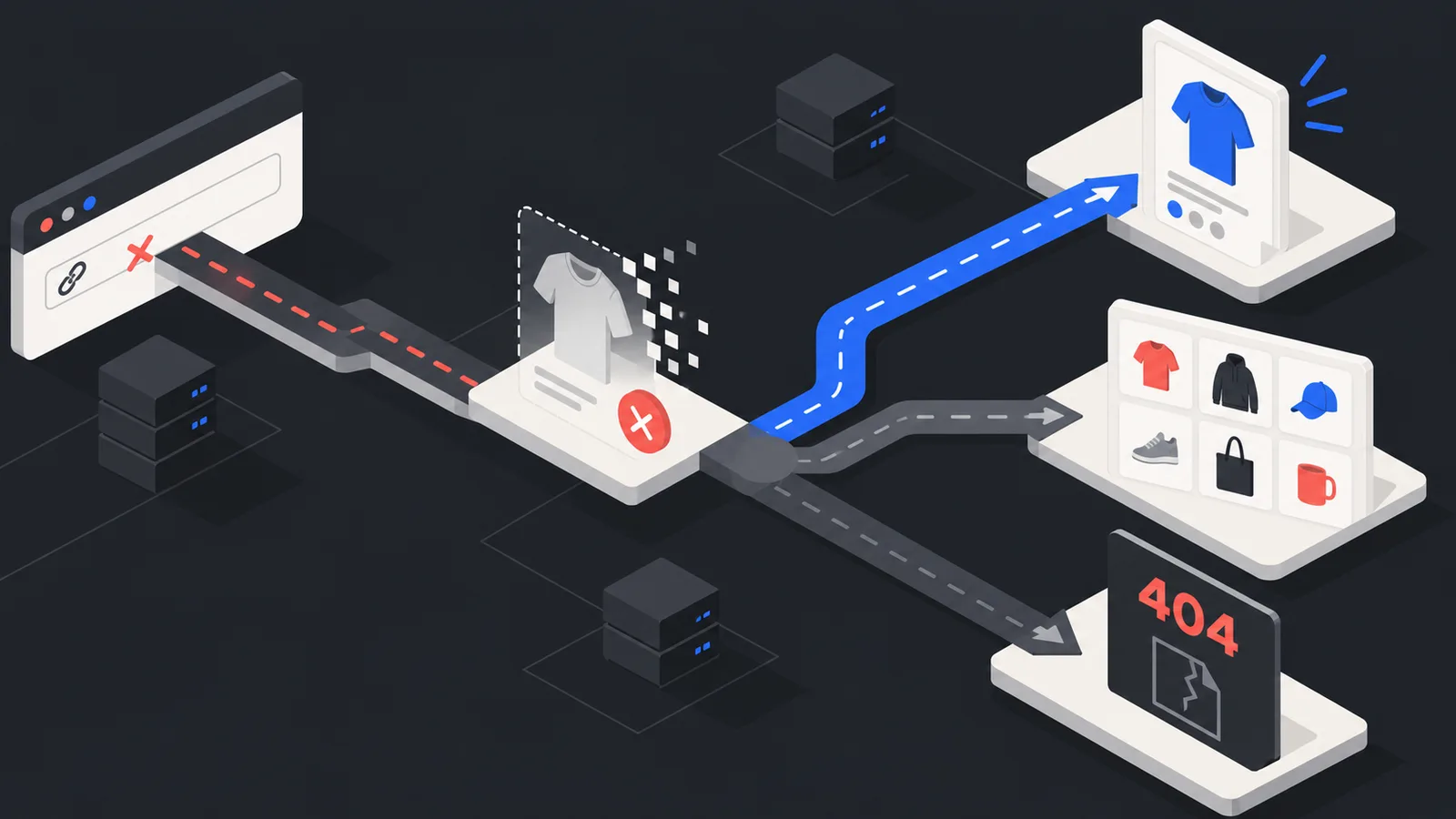
Deleting a product from Shopify does not delete every reference to its URL. Search results, backlinks, old ads, social posts, affiliate links, and customer bookmarks may continue sending visitors to the old product path.
That makes the next decision important: should the URL redirect, and if so, where?
Redirect to a direct replacement when one exists
If a new product replaces the old one and serves essentially the same intent, redirecting directly to the replacement is usually the strongest option.
/products/old-running-shoe → /products/new-running-shoe
The destination should satisfy what the visitor expected from the original URL.
Use a relevant collection only when it is genuinely useful
If there is no one-to-one replacement but the product belongs to a tightly relevant collection, that collection can sometimes be a useful fallback.
Avoid using broad categories simply because they exist. Relevance matters more than eliminating every 404.
A true 404 can be correct
If the product is permanently gone and there is no meaningful equivalent, returning a real 404—or 410 in an appropriate permanent-removal workflow—can be more accurate than forcing visitors to an unrelated page.
Redirecting every deleted product to the homepage is usually a poor match for user intent.
Prioritize old URLs that still receive real traffic
Large stores can accumulate thousands of historical product URLs. Instead of creating speculative redirects for all of them, prioritize URLs with:
organic visits
backlinks
paid campaign traffic
email or affiliate traffic
repeated human requests
How no404 helps
no404 makes real 404 requests visible, allowing the store team to see which deleted product URLs still matter.
Example:
/products/summer-shoe-2025 → real visitor → 404 detected → relevant replacement identified → redirect added.
The result is a traffic-driven redirect strategy instead of a large static redirect list based on guesses.
Avoid redirect chains
When adding a redirect, point the old URL directly to the final live destination. Avoid structures such as old product → older replacement → current product.
Conclusion
There is no universal destination for every deleted Shopify product. Use a direct replacement when possible, a tightly related collection when useful, and a true error status when no legitimate replacement exists. no404 helps surface the URLs that deserve attention first.